
5 Overlooked Lung Cancer Warning Signs
FACTS Health & Wellness Edition
Lung cancer is the leading cause of cancer-related deaths worldwide, responsible for approximately 1.8 million deaths each year according to the World Health Organization. Despite its prevalence, many cases are not caught until the disease has already reached an advanced stage. One of the most significant reasons for late diagnosis is that many early warning signs are subtle, easy to dismiss, or mistakenly attributed to other, less serious conditions. Being informed about these overlooked signals can be genuinely life-saving.
Most people associate lung cancer with a severe, persistent cough or coughing up blood. While those symptoms are indeed red flags, they often appear in later stages of the disease. The signs discussed in this article tend to emerge earlier — and that is precisely why recognizing them matters so much. Early detection dramatically improves survival rates, with five-year survival rates for localized lung cancer reaching as high as 63%, compared to just 7% for distant-stage disease.
Whether you are a current or former smoker, have been exposed to environmental hazards, or simply want to protect your long-term health, understanding the full picture of lung cancer symptoms is an important step toward proactive care.
Warning Sign #1: Unexplained, Persistent Shoulder or Back Pain
Why People Miss It
Most individuals who experience shoulder or back pain immediately think of muscle strain, poor posture, arthritis, or an old injury — not lung cancer. This assumption is understandable, because musculoskeletal pain is extremely common. However, when that pain has no obvious physical cause and does not respond to typical treatments like rest, stretching, or over-the-counter pain medication, it deserves further medical investigation.
The Medical Explanation
Lung tumors located in the upper portion of the lung — known as Pancoast tumors — can press directly against nerves, ribs, and blood vessels in the surrounding area. This pressure often causes pain that radiates into the shoulder, upper back, or even down the arm. Additionally, lung cancer can spread to the spine or chest wall, producing back pain that patients frequently chalk up to aging or physical overuse.
What to Watch For
Pain that is present at rest, worsens at night, does not improve with standard pain relief, or is accompanied by weakness or numbness in the arm or hand should be evaluated promptly by a physician. These characteristics separate cancer-related pain from common musculoskeletal issues.
Key Fact: Pancoast tumors account for roughly 3–5% of all lung cancers. Because of their location at the top of the lung, they are particularly prone to causing shoulder and arm symptoms rather than traditional respiratory complaints.
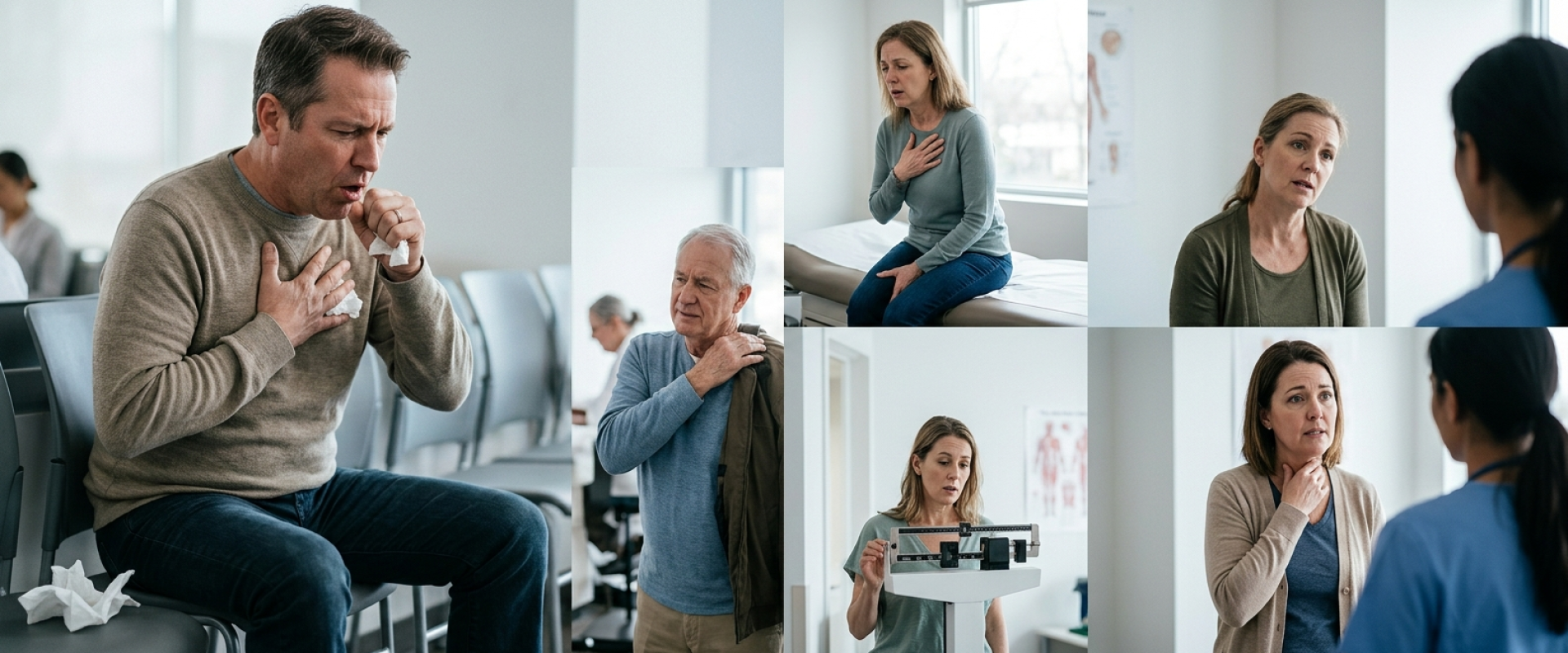
Warning Sign #2: A Hoarse or Significantly Changed Voice
Easy to Dismiss
A hoarse voice is something most people experience from time to time, usually as a result of a cold, a sore throat, excessive talking, or seasonal allergies. It is one of those symptoms that is almost universally self-diagnosed as minor and expected to resolve on its own within a week or two. When it does, there is no cause for concern. When it does not, however, the cause needs to be explored more thoroughly.
The Connection to Lung Cancer
A lung tumor that grows near or presses upon the recurrent laryngeal nerve — a nerve that controls the vocal cords — can cause persistent hoarseness. This nerve travels a surprisingly long path through the chest cavity, meaning that a tumor located well away from the throat can still disrupt its function. The result is a voice that sounds raspy, weak, or noticeably different from usual.
When to Seek Evaluation
Hoarseness that lasts longer than two to three weeks without a clear explanation such as a respiratory infection or vocal strain should be assessed by a doctor. This is especially important for individuals over the age of 50 or those with a history of smoking or tobacco use.
Warning Sign #3: Swelling in the Face, Neck, or Arms
An Unusual but Real Symptom
Swelling of the face, neck, or upper arms is not a symptom that most people would connect to lung cancer. It tends to look like an allergic reaction, an infection, or even a side effect of medication — which means it is frequently treated as such before the true underlying cause is identified.
Superior Vena Cava Syndrome
This type of swelling can be caused by a condition called Superior Vena Cava (SVC) Syndrome. The superior vena cava is a large vein that carries blood from the head, neck, arms, and chest back to the heart. When a lung tumor — particularly one in the upper right portion of the lung — grows large enough to compress or block this vein, blood flow becomes obstructed. The resulting backup of blood causes visible swelling, redness, and a sensation of fullness or pressure in the affected areas.
Additional Symptoms of SVC Syndrome
- Headaches that worsen when bending forward or lying down
- Dizziness or lightheadedness
- Shortness of breath
- Blurred vision
- Dilated veins visible on the chest or neck
SVC Syndrome is considered a medical emergency in severe cases and requires immediate evaluation. Lung cancer is one of the most common causes of this condition.
Key Fact: According to oncology research, lung cancer accounts for approximately 65–80% of all cases of Superior Vena Cava Syndrome. Small cell lung cancer and non-small cell lung cancer are both known to produce this complication.
Warning Sign #4: Unexplained, Gradual Weight Loss and Fatigue
The "It Must Be Stress" Assumption
Unintentional weight loss and persistent fatigue are two of the most commonly overlooked cancer symptoms across all cancer types, not just lung cancer. This is because both symptoms are extremely common in the general population and are usually explained by stress, poor sleep, dietary changes, or increased physical activity. People often welcome unexplained weight loss without questioning its source, particularly if they have been trying to lose weight.
How Lung Cancer Causes These Symptoms
Cancer cells consume enormous amounts of energy as they rapidly divide and grow. The body's immune system also burns significant energy attempting to fight the disease. Together, these biological processes can cause the body to lose weight and feel persistently drained even without changes in diet or activity level. Additionally, some lung tumors secrete substances called cytokines that interfere with metabolism and appetite regulation.
What Qualifies as "Significant" Weight Loss
Physicians generally define clinically significant unintentional weight loss as losing 5% or more of body weight within six to twelve months without a clear explanation. For a person weighing 160 pounds, that equals roughly 8 pounds. When this type of weight loss occurs alongside persistent fatigue, loss of appetite, or other symptoms listed in this article, it is important to consult a doctor without delay.
Fatigue That Doesn't Improve With Rest
Cancer-related fatigue is qualitatively different from ordinary tiredness. It tends to be more severe, does not resolve with a good night's sleep, and can interfere significantly with daily functioning. Patients frequently describe it as a heavy, overwhelming exhaustion that is unlike anything they have experienced from normal daily life demands.
Warning Sign #5: Recurring Respiratory Infections
A Pattern Hidden in Plain Sight
Respiratory infections such as bronchitis and pneumonia are common illnesses that most people experience occasionally throughout their lives. Having one or even two infections in a year is not unusual. However, when these infections begin to recur repeatedly, take an unusually long time to clear up, or keep returning in the same location in the lung, this pattern can be a critical warning sign of an underlying problem — including lung cancer.
Why Lung Tumors Cause Repeated Infections
A tumor growing inside or near a bronchial tube can partially or completely block the airway. When an airway is blocked, normal mucus secretions cannot drain properly, and bacteria are more likely to accumulate in the stagnant area. This creates an environment where infections establish themselves repeatedly. Doctors sometimes refer to this as "post-obstructive pneumonia," and it is a recognized early indicator of lung malignancy.
Red Flags Within Respiratory Illness
If you or someone you know experiences any of the following patterns, a chest X-ray or further imaging may be warranted:
- Pneumonia or bronchitis that recurs more than twice in one year
- Infections that respond slowly or incompletely to antibiotics
- Repeated infections that appear to affect the same area of the lung
- Respiratory illness accompanied by unexplained weight loss or a persistent cough
- Wheezing that is new and not associated with asthma or allergies
Key Fact: Studies published in thoracic oncology journals have found that a significant number of lung cancer patients were previously treated for pneumonia — sometimes multiple times — before a tumor was ultimately identified as the root cause of their recurring infections.
Who Is at Greatest Risk?
Smokers and Former Smokers
Smoking remains the single largest risk factor for lung cancer, responsible for approximately 80–85% of all cases in the United States. The risk increases with both the number smoked per day and the number of years a person has smoked. Importantly, the risk does not disappear immediately upon quitting. Former smokers remain at elevated risk for many years, which is why high-risk individuals are encouraged to undergo regular low-dose CT screening.
Non-Smokers Are Not Immune
Roughly 10–15% of lung cancer diagnoses occur in people who have never smoked. Known risk factors for non-smokers include:
- Radon gas exposure: Radon is a naturally occurring radioactive gas that seeps from the ground and can accumulate in homes and buildings. It is the second leading cause of lung cancer in the United States.
- Secondhand smoke: Regular exposure to others' smoke meaningfully increases lung cancer risk.
- Occupational hazards: Asbestos, arsenic, diesel exhaust, and certain industrial chemicals are established lung carcinogens.
- Air pollution: Long-term exposure to high levels of outdoor air pollution has been classified as a Group 1 carcinogen by the International Agency for Research on Cancer (IARC).
- Family history: Having a first-degree relative with lung cancer increases an individual's risk, suggesting a genetic component to the disease.
The Importance of Early Screening
Low-Dose CT Screening
The U.S. Preventive Services Task Force (USPSTF) recommends annual low-dose computed tomography (LDCT) screening for adults aged 50 to 80 years who have a significant smoking history — defined as 20 pack-years or more — and who currently smoke or have quit within the past 15 years. This type of screening has been shown to reduce lung cancer mortality by approximately 20% in high-risk populations.
Talking to Your Doctor
If you fall into a high-risk category or if you have noticed any of the warning signs described in this article, the most important step you can take is to speak openly with your healthcare provider. Many of these symptoms have other explanations, and experiencing one of them does not mean you have lung cancer. However, unexplained, persistent, or unusual symptoms always deserve professional evaluation rather than watchful waiting at home.
Do not hesitate to advocate for yourself in a medical setting. If you feel your symptoms are being dismissed, it is entirely appropriate to ask whether additional testing such as imaging studies, pulmonary function tests, or a referral to a pulmonologist or oncologist might be appropriate given your personal risk factors and symptom history.
Final Thoughts
Lung cancer does not always announce itself loudly. Its earliest warning signs are often quiet, gradual, and easy to attribute to far less serious causes. Shoulder pain, voice changes, facial swelling, unexplained fatigue and weight loss, and recurring respiratory infections are not symptoms that most people would automatically connect to their lungs — but they can be important early signals that warrant attention.
The medical community has made meaningful progress in lung cancer treatment in recent years, including targeted therapies, immunotherapy, and minimally invasive surgical techniques. However, these advances are most effective when the disease is caught early. Knowledge is one of the most powerful tools available in that pursuit.
Share this information with family and friends, especially those who may be in higher-risk groups. Awareness, open communication with healthcare providers, and appropriate screening remain the cornerstones of better outcomes for one of the world's most prevalent and serious cancers.
Sources and References: World Health Organization (WHO) Cancer Fact Sheets | American Cancer Society Lung Cancer Statistics | U.S. Preventive Services Task Force LDCT Screening Guidelines | International Agency for Research on Cancer (IARC) | National Cancer Institute (NCI) SEER Database | American Thoracic Society Clinical Practice Guidelines
This article is intended for general informational purposes only and does not constitute medical advice. Always consult a qualified healthcare professional regarding any health concerns or before making any decisions related to your health or treatment.
Related Articles

Some Meal Delivery Services Are Absolutely Perfect For Families
Raising a family takes a lot of time.

Top 5 Foods for Chronic Kidney Disease
Living with chronic kidney disease, often called CKD, usually means paying closer attention to food choices.

7 Foods That Can Trigger Severe Allergies
Food allergies can turn an ordinary meal into a medical emergency within minutes.

5 Key Insights from Gene Testing
Gene testing can reveal useful information about health, family history, and how the body works.

Tasty and Easy Cupcakes Are Always a Delicious Choice
Cupcakes are a great treat that are enjoyed by millions around the world.

Home Remedies Are Some of the Best Ways To Prevent Constipation
No one enjoys the feeling of constipation.
Recent Articles
-

Cervical Cancer: Warning Signs & Treatment
Cervical cancer is one of the most common cancers affecting women worldwide, yet it is also one of the most preventable and treatable when detected ea ...
-

5 Overlooked Lung Cancer Warning Signs
FACTS Health & Wellness EditionLung cancer is the leading cause of cancer-related deaths worldwide, responsible for approximately 1.8 million deaths e ...
-

7 Warning Signs of Breast Cancer
Breast cancer is one of the most common cancers affecting people worldwide. According to the World Health Organization, it is the most frequently diag ...